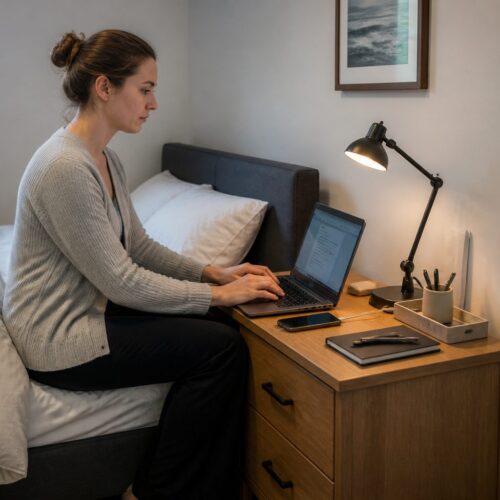


Consider a stool or a backless chair if your work sessions are typically short, as these offer the ultimate tuck-away solution. However, prioritize ergonomic support if you spend extended periods at your bedroom workspace setup to prevent strain.
Test the chair with the desk before purchasing to ensure a comfortable fit and adequate legroom. This prevents the frustration of discovering your new chair doesn’t quite fit the space you meticulously planned for your compact desk.
Lighting a bedroom desk without disturbing a partner
Effective lighting is essential for any workspace, but it poses a unique challenge in a narrow writing desk bedroom office, particularly if you share the room. You need enough light for your tasks without disrupting someone trying to sleep.
A focused task lamp with an adjustable head and dimmer switch is your best friend in this scenario. This allows you to direct light precisely where you need it, minimizing spillover into the rest of the room.
Opt for warm, soft light temperatures (around 2700K to 3000K) over bright, cool white light, which can be harsh and stimulating. Warm light is generally less disruptive to sleep cycles and creates a cozier atmosphere.

Consider lamps that clip directly onto your slim desk bedroom or wall-mounted options that free up valuable surface area. This keeps the light source close to your work, reducing the need for a brighter, more expansive glow.
If possible, position your desk light on the side opposite your partner’s sleeping area to further minimize disturbance. This strategic placement ensures your work sessions don’t inadvertently keep them awake, maintaining harmony in the room.
Locking in focus: acoustic and visual separation strategies
Maintaining focus in a narrow writing desk bedroom office can be tough, especially when the lines between work and rest are blurred. Strategic acoustic and visual separation techniques are key to creating a truly productive environment.
For acoustic separation, consider investing in noise-canceling headphones to block out household sounds or ambient noise. They create a personal sound bubble, allowing you to concentrate on calls or tasks without external distractions.
Thick curtains or fabric panels can help absorb sound within the room, reducing echo and making your workspace feel more insulated. Even a plush rug can contribute to dampening sound, creating a calmer atmosphere for your bedroom workspace setup.
Visually, a small room divider or even a tall bookcase placed strategically can create a sense of enclosure around your slim desk bedroom. This helps mentally separate your work zone from the rest of the bedroom, signaling it’s time to focus.
Keep your desk area clear of personal items not related to work to minimize visual distractions. A clean, uncluttered surface encourages a clear mind, making it easier to dive into tasks without feeling overwhelmed by your surroundings.
When a narrow desk works — and when a different form factor suits better
A narrow writing desk bedroom office is an excellent solution for many, but it’s not a universal fit for every user or every type of work. Understanding its limitations is just as important as knowing its benefits to make the best choice.
This type of desk works best for individuals who primarily use a laptop, a single monitor, and minimal physical paperwork. It’s ideal for writing, coding, online meetings, or light administrative tasks that don’t require extensive spread-out space.
If your work involves multiple large monitors, extensive reference materials, or physical creative projects that need a lot of room, a small writing desk under 40 inches might prove too restrictive. You’ll quickly run out of usable surface area.
For those needing more space, a folding desk that can be tucked away completely might be a better option than a permanently fixed narrow desk. This offers flexibility for larger tasks while reclaiming the entire room when work is done.
Consider a corner desk if you have an unused corner that can accommodate more depth and width than a straight wall allows. This can provide a surprisingly spacious bedroom workspace setup without consuming too much linear wall space.
Ultimately, the best desk for your bedroom depends on your specific work habits, the size of your room, and your commitment to maintaining work-life balance. Evaluate your needs honestly before settling on the perfect compact desk against wall.
Remote work and hybrid models have blurred the lines between home and office for many professionals across the country. Our bedrooms, once sanctuaries solely for rest, often now pull double duty as concentrated work zones, requiring smart solutions.
Finding a dedicated workspace in a small home can feel like a complex puzzle, especially when every square inch counts. This is where a narrow writing desk bedroom office setup truly shines, offering a practical solution for limited square footage and creating a productive nook.
A well-chosen slim desk bedroom can transform an unused corner or wall into a productive hub without overwhelming the room’s primary function. It allows you to create a functional area for tasks, study, or creative pursuits right where you need it most, even in tight spaces.
Why bedrooms are increasingly becoming secondary workspaces
The shift to remote and hybrid work models has undeniably reshaped how and where we conduct our professional lives. Many people now find themselves needing a dedicated work spot within the confines of their homes, often leading them to the bedroom.
Bedrooms frequently offer the quietest retreat in a busy household, making them a natural choice for focused work sessions. This quiet environment helps minimize distractions from family members, pets, or household chores during important meetings or deep work.
Not every home has a spare room that can be converted into a traditional home office, forcing creative solutions. Homeowners and renters alike are getting ingenious about utilizing every available space, including those previously reserved strictly for sleeping.
A bedroom workspace setup offers immense convenience, allowing you to transition from personal time to professional tasks with minimal fuss. This integration can save commute time and provide a more flexible schedule throughout your day, which is a huge benefit.
Designing a functional narrow writing desk bedroom office helps maintain productivity without sacrificing the room’s aesthetic or comfort. It proves that even the smallest spaces can accommodate a professional setup when planned thoughtfully.
Defining narrow: what desk widths work in bedroom environments
When we talk about a narrow writing desk bedroom office, width is arguably the most critical dimension to consider. A desk that is too wide will instantly make a small room feel cramped and uninviting, defeating the purpose of a compact solution.
For most bedrooms, especially those shared or with existing furniture, a desk width between 30 and 48 inches is generally considered ideal. This range offers enough surface area for essential items without encroaching too much on walking paths.
Many people find that a small writing desk under 40 inches provides ample space for a laptop and a few accessories. Desks in this size category are particularly effective for fitting into tight alcoves or alongside beds without causing congestion.
I personally recommend measuring your available wall space and considering the swing of any doors or drawers nearby. This simple step prevents frustrating clashes and ensures your chosen slim desk bedroom fits perfectly into its intended spot.
Don’t forget to account for the chair when determining the optimal width, ensuring there’s enough room to pull it out and push it in comfortably. A desk might fit, but if the chair can’t move, your setup becomes impractical quickly.
Optimal depth for laptop and notebook work without crowding
Beyond width, the depth of your narrow writing desk bedroom office plays a significant role in comfort and functionality. Too much depth can obstruct pathways, while too little will make your workspace feel restrictive and uncomfortable.
For typical laptop and notebook work, a desk depth between 18 and 24 inches usually provides adequate space for good posture. This allows you to place your screen at an appropriate distance while still having room for a keyboard, mouse, and a notebook.
| Desk Depth (Inches) | Primary Use Case | Pros for Bedroom Office |
|---|---|---|
| 12-16 | Minimalist, writing only | Extremely space-saving, fits almost anywhere, ideal as a compact desk against wall. |
| 17-20 | Laptop, small monitor, notebook | Good balance of space and footprint, comfortable for most tasks, common for a slim desk bedroom. |
| 21-24 | Larger monitor, multiple documents | More generous workspace, better ergonomics for extended use, still manageable in many bedrooms. |
| 25+ | Multiple monitors, extensive setup | Maximum surface area, but often too deep for a truly narrow writing desk bedroom office in tight spaces. |
Leg styles that maximize knee clearance in tight bedroom layouts
The design of your desk’s legs might seem like a minor detail, but it profoundly impacts usability, especially for a narrow writing desk bedroom office. Bulky or oddly positioned legs can quickly diminish precious knee and legroom.
Look for desks with slim, straight legs or a pedestal design that centralizes support, maximizing open space underneath. These styles allow you to sit closer to the desk and move your legs more freely, which is essential for comfort.
Trestle legs, while sometimes visually appealing, often splay outwards and can reduce valuable floor space or snag your feet. A simple A-frame or sled base can offer stability without excessive bulk, keeping your slim desk bedroom functional.
Wall-mounted desks are another excellent option, as they eliminate legs entirely, providing unparalleled knee clearance and a clean aesthetic. This design is particularly effective for a compact desk against wall setup, freeing up floor space.
When choosing, consider how much you shift in your chair and whether your legs tend to stretch out or stay tucked. Opting for a leg style that accommodates your natural sitting habits will make your bedroom workspace setup far more enjoyable.
How to position a narrow desk to protect sleep-work boundaries
Integrating a narrow writing desk bedroom office requires careful thought about its placement to maintain a healthy sleep-work boundary. Your bedroom should remain a haven for rest, not just another extension of your daily grind.
Avoid placing the desk directly facing your bed, as this visual connection can make it harder to switch off mentally at night. A setup that keeps the desk out of your direct line of sight from the bed helps reinforce that separation.
Consider positioning your slim desk bedroom against a wall that isn’t immediately visible upon entering the room, or tuck it into an alcove. This allows the workspace to feel somewhat contained and less dominant in the room’s overall layout.
If possible, choose a spot near a window for natural light, which can boost mood and productivity during the day. However, ensure the desk isn’t positioned such that screen glare becomes an issue, as this can strain your eyes unnecessarily.
Using a room divider or a strategically placed tall plant can also help create a subtle visual barrier between your work zone and your sleep zone. This small effort can make a big difference in maintaining mental separation and ensuring restful nights.
Cable management on a slim desk: keeping surfaces uncluttered
A tidy workspace is crucial for productivity, and on a narrow writing desk bedroom office, effective cable management becomes even more important. Clutter can quickly overwhelm a small surface, making it feel messy and distracting.
Loose cables not only look untidy but also create trip hazards and make cleaning more difficult. Investing in smart cable management solutions will help keep your slim desk bedroom looking sleek and professional.
- Utilize adhesive cable clips to secure wires to the underside of the desk.
- Invest in a small cable management box to hide power strips and excess cable length.
- Use hook-and-loop fasteners or zip ties to bundle cables together neatly.
- Consider a desk with built-in cable pass-throughs or a rear lip for routing.
- Opt for wireless peripherals like a mouse and keyboard to reduce cable count.
- Mount a power strip to the underside of the desk to keep outlets off the floor.
Pairing a narrow desk with wall shelves to extend vertical storage
When floor space is limited, the only way to go is up, and wall shelves are your best friend for a narrow writing desk bedroom office. They provide essential storage without consuming any additional footprint, maximizing your available area.
Installing floating shelves directly above your slim desk bedroom creates an integrated storage solution for books, files, or decorative items. This keeps your desktop clear for actual work, making the space feel less cluttered and more efficient.
Modular shelving systems can be customized to fit specific wall dimensions and storage needs, offering flexibility as your workspace evolves. You can mix open shelves with closed cabinets for both display and discreet storage of less attractive items.
Consider the height and depth of your shelves to ensure they are easily accessible without obstructing your view or causing head bumps. Shallow shelves are often best for a small writing desk under 40 inches, maintaining a streamlined look.
Think about incorporating pegboards or magnetic strips alongside your shelves for quick access to frequently used small items like pens, scissors, or sticky notes. This keeps them off the desk surface but still within arm’s reach for convenience.
Choosing a chair that tucks fully under a slim profile desk
The right chair is just as important as the desk itself, especially when optimizing a narrow writing desk bedroom office setup. A chair that doesn’t tuck away neatly can disrupt pathways and make your small space feel perpetually messy.
Look for armless chairs or those with arms that are specifically designed to fit under standard desk heights. This seemingly small detail makes a huge difference in maintaining a tidy and functional slim desk bedroom environment when not in use.
Swivel chairs without bulky bases or oversized wheels are generally a good choice, as they offer flexibility and can be easily maneuvered into place. A chair with a compact footprint ensures it doesn’t take up too much room when pulled out.
Consider a stool or a backless chair if your work sessions are typically short, as these offer the ultimate tuck-away solution. However, prioritize ergonomic support if you spend extended periods at your bedroom workspace setup to prevent strain.
Test the chair with the desk before purchasing to ensure a comfortable fit and adequate legroom. This prevents the frustration of discovering your new chair doesn’t quite fit the space you meticulously planned for your compact desk.
Lighting a bedroom desk without disturbing a partner
Effective lighting is essential for any workspace, but it poses a unique challenge in a narrow writing desk bedroom office, particularly if you share the room. You need enough light for your tasks without disrupting someone trying to sleep.
A focused task lamp with an adjustable head and dimmer switch is your best friend in this scenario. This allows you to direct light precisely where you need it, minimizing spillover into the rest of the room.
Opt for warm, soft light temperatures (around 2700K to 3000K) over bright, cool white light, which can be harsh and stimulating. Warm light is generally less disruptive to sleep cycles and creates a cozier atmosphere.
Consider lamps that clip directly onto your slim desk bedroom or wall-mounted options that free up valuable surface area. This keeps the light source close to your work, reducing the need for a brighter, more expansive glow.
If possible, position your desk light on the side opposite your partner’s sleeping area to further minimize disturbance. This strategic placement ensures your work sessions don’t inadvertently keep them awake, maintaining harmony in the room.
Locking in focus: acoustic and visual separation strategies
Maintaining focus in a narrow writing desk bedroom office can be tough, especially when the lines between work and rest are blurred. Strategic acoustic and visual separation techniques are key to creating a truly productive environment.
For acoustic separation, consider investing in noise-canceling headphones to block out household sounds or ambient noise. They create a personal sound bubble, allowing you to concentrate on calls or tasks without external distractions.
Thick curtains or fabric panels can help absorb sound within the room, reducing echo and making your workspace feel more insulated. Even a plush rug can contribute to dampening sound, creating a calmer atmosphere for your bedroom workspace setup.
Visually, a small room divider or even a tall bookcase placed strategically can create a sense of enclosure around your slim desk bedroom. This helps mentally separate your work zone from the rest of the bedroom, signaling it’s time to focus.
Keep your desk area clear of personal items not related to work to minimize visual distractions. A clean, uncluttered surface encourages a clear mind, making it easier to dive into tasks without feeling overwhelmed by your surroundings.
When a narrow desk works — and when a different form factor suits better
A narrow writing desk bedroom office is an excellent solution for many, but it’s not a universal fit for every user or every type of work. Understanding its limitations is just as important as knowing its benefits to make the best choice.
This type of desk works best for individuals who primarily use a laptop, a single monitor, and minimal physical paperwork. It’s ideal for writing, coding, online meetings, or light administrative tasks that don’t require extensive spread-out space.
If your work involves multiple large monitors, extensive reference materials, or physical creative projects that need a lot of room, a small writing desk under 40 inches might prove too restrictive. You’ll quickly run out of usable surface area.
For those needing more space, a folding desk that can be tucked away completely might be a better option than a permanently fixed narrow desk. This offers flexibility for larger tasks while reclaiming the entire room when work is done.
Consider a corner desk if you have an unused corner that can accommodate more depth and width than a straight wall allows. This can provide a surprisingly spacious bedroom workspace setup without consuming too much linear wall space.
Ultimately, the best desk for your bedroom depends on your specific work habits, the size of your room, and your commitment to maintaining work-life balance. Evaluate your needs honestly before settling on the perfect compact desk against wall.