
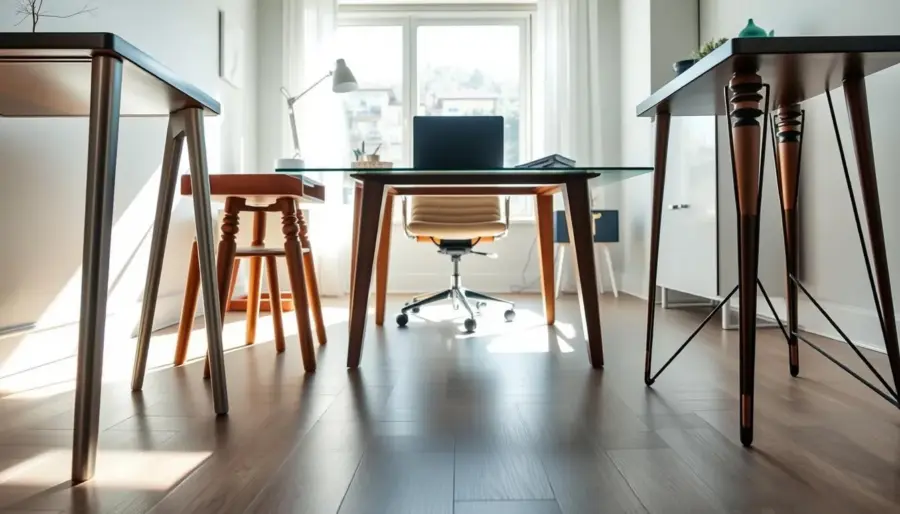
You want a desk that fits your body and the room. This introduction shows how different desk leg styles change two things: the space your body uses and the space your eyes read. Understanding this helps a desk feel “just right” instead of too big.
Support leg geometry gives a practical way to judge a base. Look at how legs, rails, and braces form shapes that either preserve or block clearance under the top. That quick check saves time when shopping online or measuring at home.
You will learn simple triangle thinking — not advanced math — to predict collisions with knees, shins, or chair arms. This short study uses everyday measurement and fast checks so you can act with confidence.
Later you’ll record key dimensions, run a clearance check, and compare common styles like four-post, trestle, pedestal, sled/U, X-frame, and hairpin. Use this as a practical resource when fitting a desk into a home office, bedroom, or studio apartment in the United States.
Key takeaways: Learn to spot shapes that block clearance, apply triangle checks instead of complex math, and use simple measurements as reliable resources while you shop.
Why desk leg style changes what your small room feels like
Legroom is a physical need: your knees and shins require a clear path when you sit. If a bar or brace sits where your legs travel, you notice the collision immediately. That reduces comfort and limits chair movement.
Visual space is different. Your eye tracks open areas under and around the desk. When you can see “through” the base from several angles, the top reads lighter and the whole footprint seems smaller.

The idea of open triangles and negative space is simple. Triangles formed by rails and sides, or empty triangles left by splayed legs, let light and sight pass. Those empty shapes make the desk feel less blocky even if the tabletop stays the same size.
- What “support geometry” means: how the frame’s sides, rails, and braces create load-bearing shapes that can intrude into your knee path.
- Structure matters: consistent, rigid frames feel stable and predictable, while odd braces create repeat bump zones.
- Angles change clearance: a small change in tilt or stretcher placement alters usable knee space the moment you sit down.
Over the next sections you’ll learn to judge both legroom and sightlines together, so you avoid a base that looks airy but still clips your shins. In short, pay attention to triangles and angles as a quick, practical concept to save time and avoid surprises.
Support leg geometry basics: triangles, angles, and clearance
Small frames and diagonal braces often form a right triangle where the floor, an upright, and a brace meet. That triangle controls the space under the top and decides if a brace becomes a shin nuisance or stays out of the way.

How a right triangle shows up in real frames
Many desk braces, splayed posts, and corner supports create right triangles. The floor and an upright meet at 90 degrees while a diagonal brace becomes the hypotenuse. That hypotenuse is strong, but it can be the first contact point for your knee if it sits inside your seated path.
Quick-clearance math: Pythagorean theorem c² = a² + b²
The theorem states that in a right triangle the hypotenuse length (c) links to the other two sides (a and b). If you know the vertical drop under the apron and the horizontal inset from the front edge, plug them into the equation. You get the diagonal length and a simple estimate of where the brace crosses your knee line.
Angle effects and congruent triangles for stability
A leg tilted a few degrees outward widens the footprint and can move contact points toward your feet. Small changes in degrees change perceived openness but also affect usable knee space.
- Practical lesson: Match left and right triangle shapes for steadier frames.
- HL idea in plain terms: If two braces share the same hypotenuse and one leg length, their triangles mirror each other and resist side-to-side wobble.
- Quick check: Measure two sides, run the theorem, and mark where the hypotenuse would fall before you buy.
How to measure your space and predict legroom before you buy
A short measuring routine saves you from returns and awkward setups. Start by recording four exact lengths on the listing or your current desk so you can judge clearance fast.
Key lengths to record
- Top depth — how far the tabletop extends toward the chair.
- Apron height (underside clearance) — space for thighs under the top.
- Inset from the front edge — where vertical or diagonal members sit.
- Foot spread on the floor — how wide the base reaches for toe and walk space.
A quick equation check using two sides
Use the vertical drop (apron height) and horizontal inset as your two sides. Apply c² = a² + b² to estimate where a diagonal brace would cross the plane of your knees.
This one simple equation keeps the math light while giving a clear sanity check on likely collision points.
Real-world test you can do in minutes
Outline the desk footprint with painter’s tape, pull your chair in, and swivel. Note armrest width, swivel radius, and how far back you sit — those chair functions change the real case even when numbers look fine.
Watch for common problems: missing underside dimensions or confusing apron vs. stretcher terms. A few minutes now saves time later.
Desk leg styles compared for small rooms and tight leg clearance
Desk bases change how your knees, shins, and chair arms move under the top. This matters most in small rooms where even small obstructions become constant problems.
Four corner posts and why they steal usable space
Four-post frames place vertical posts at the corners and often sit right where your chair arms or knees swing. If the posts are not inset, they create obvious pinch points when you cross your legs or shift back.
Tapered or inset options that open the feel under the top
Tapered or inset designs move the hard stops away from the front edge. That gives clearer sightlines and more usable knee room without changing tabletop depth.
Trestle bases and center rails: where shins hit first
Trestles add a center stretcher that often sits at shin height. The stretcher’s depth and height determine whether it becomes a persistent bump during long sessions.
Pedestal bases for maximum freedom and swivel movement
Pedestal setups free the central zone so your chair swivels and slides with fewer obstructions. Note that bulky pedestals can still limit foot placement near the floor.
Sled and U-shaped bases: clean sightlines, toe-kick limits
Sled or U shapes read light from a distance. Their bottom bar, however, can reduce toe-kick clearance depending on placement and height.
X-frames and cross-bracing: strong triangles that cut pass-through space
X-frames use diagonal members that form visible triangles. The diagonal hypotenuse often crosses the knee path, so strength comes at the cost of predictable bump points.
Hairpin and splayed options: visual lightness vs. wider footprint
Hairpin and splayed bases look airy, but outward angles increase the floor footprint. In tight rooms this can interfere with feet, cables, or nearby furniture.
- Quick comparison: Pedestal — best for clear central space.
- Best sightlines: Tapered/inset or sled bases.
- Watch this: X-frames and trestles for hypotenuse and stretcher collision points.
How to choose a desk that looks smaller without feeling cramped
Pick a base that keeps sightlines open while leaving real knee space where you sit. Start with two quick checks: can you see the floor beneath the top, and does anything cross your seated knee path when you pull the chair in?
Optimizing visual space: thinner legs, open sides, and fewer “hard stops” for the eye
Thin, narrow legs and minimal cross-members reduce visual “hard stops” and make the top read lighter. When the floor is visible, a desk appears smaller even if the tabletop size stays the same.
Quick look-for words: “inset,” “apron clearance,” and “pedestal setback.” Use these in listings to judge how open the base will read from a distance.
Optimizing legroom: avoiding front stretchers and checking knee path at seated angles
Avoid front stretchers unless their height matches your sitting posture. Your shins point forward and knees rise when seated, so evaluate clearance along that angled path — not just straight on.
- Checklist: open sides, minimal under-desk clutter, stretcher placement, and top depth versus underside lengths.
- Practical tip: braces set farther back or higher keep triangles for strength while staying out of your entry zone.
- Decision words: “stretcher,” “cross brace,” and “apron clearance” help you scan specs fast.
Common geometry problems and quick fixes when a desk feels tight
When a desk feels cramped, a simple sit-and-rotate routine usually finds the culprit fast. Start by sitting normally, then turn your knees outward and inward. Note the first touch point and map it to any diagonal member under the top.
When the “hypotenuse” becomes your shin hazard: diagnosing diagonal braces
Often the diagonal brace is the hypotenuse of a right triangle formed by the floor and an upright. If that diagonal sits forward it will intercept your shin path. Use the Pythagorean theorem as a quick check: longer diagonal placed near the front cuts deeper into usable space.
- Step test: sit, note touch point, trace it to the brace line.
- Triangles congruent: mirrored braces give stability but will hit both sides if placed poorly.
- Isosceles triangle cases: two equal diagonals can widen the obstruction more than one bar does.
Adjustments that buy space fast: chair height, keyboard tray choice, and repositioning
Try small changes first. Raise or lower your chair to change knee angle. Swap to a slimmer keyboard tray or remove it to step back slightly.
Reposition the desk a few inches or retape the brace projection with painter’s tape. Sit again to confirm the fix before you invest time or money.
- Quick fixes you can do now: adjust height, change tray, reposition desk.
- Simple study step: mark brace projection and repeat the sit test to verify results.
- When to consider a swap: if congruent triangles place sides equal across your knee path, the problem repeats every time.
Conclusion
, A well-chosen base keeps your knees clear and the room feeling open without shrinking your usable top.
Frame shapes tell the story. Spot a triangle or two and note the positions of the sides that cross your seated path. Use simple math to estimate whether a diagonal will hit your shins.
Measure key lengths, run a quick two-side clearance check, and do a tape test with your chair before you buy. Remember that congruent triangles in bracing add rigidity but may mirror the same pinch points on both sides.
Quick checklist: confirm underside clearance, locate stretchers, look for inset or pedestal space, and visualize your seated angles. Treat this study as repeatable math you can use any time you move or upgrade accessories.