

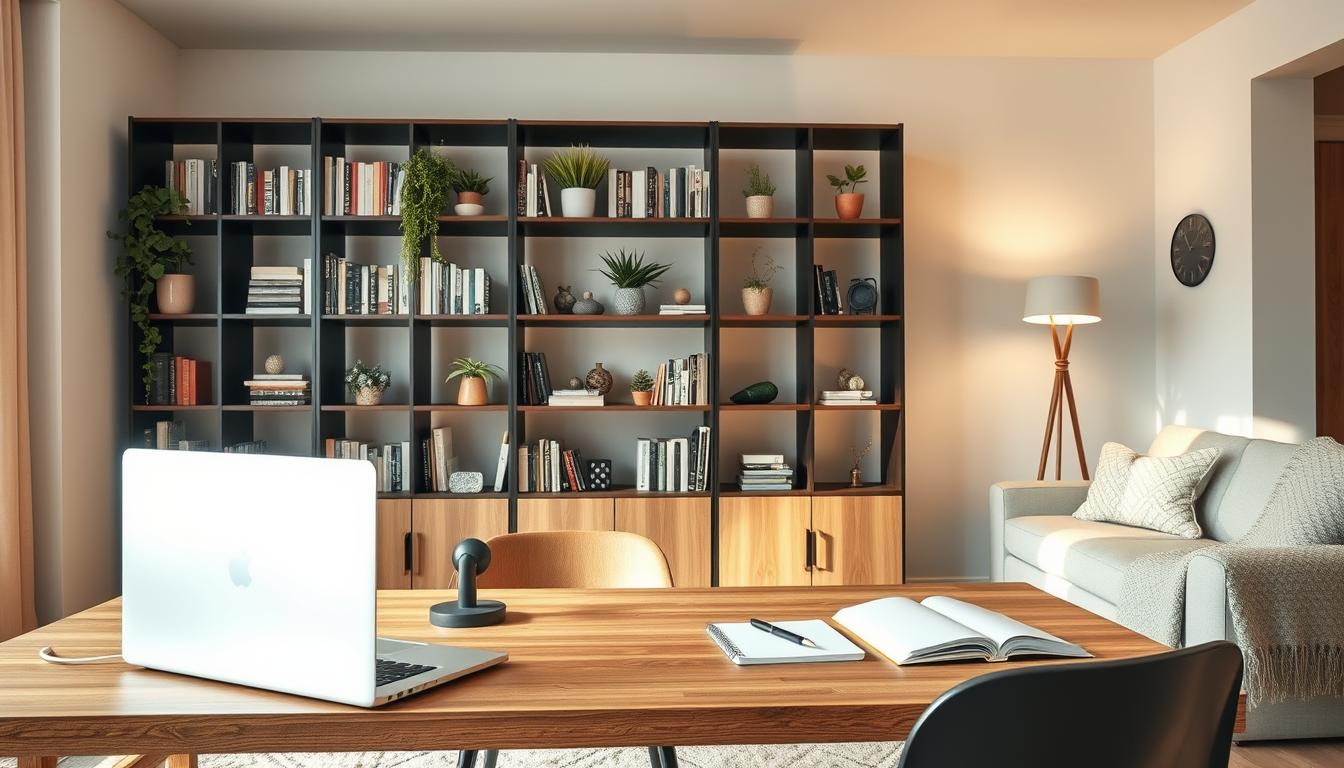
Open layouts feel modern, but they can blur your work area and your life. You need an office boundary without building walls or altering your rental. Shelving systems give you a flexible, renter-friendly fix that adds storage and structure.
Think of shelving as a multiuse divider that zones your layout. It creates visual separation, helps control traffic flow, and gives you a neat backdrop for calls. Brands like National Business Furniture and Versare sell modular shelves designed to adapt as needs change.
Know what to expect: a shelf can offer partial privacy and storage, but it won’t fully block sound like a built wall. In this guide you’ll learn how to measure, compare shelves vs panels, pick materials, and plan layout so your workspace feels intentional.
We’ll cover height, width, stability, lighting, and sound options so you can choose the right setup for your home and daily privacy needs.
Why Shelving Units Work as a Room Divider for Open-Apartment Offices
Shelving gives you a practical way to define a dedicated office area without building walls. In an open apartment, a shelf signals a change of purpose so your brain knows when work begins and ends.

Define a dedicated office space without building walls
A freestanding shelf creates a clear work zone inside one room. That visible boundary helps you protect routines and switch off at the end of the day.
Improve focus by shaping traffic flow and sightlines
Place shelving to steer walk paths away from your desk. You reduce visual interruption and make a calmer sightline for calls and deep work.
Add storage and display without sacrificing functionality
Shelves beat many panels because they add storage for supplies, files, and tech while still separating areas. Use books, plants, and baskets to blend the solution into your interior design so it feels intentional.
- Creates a “this is work” cue inside a single room
- Redirects traffic to cut distractions
- Combines storage and screening for better functionality
Room divider offices: What You’re Really Buying in a Boundary Solution
What you buy when you add a partition is often less about walls and more about control—control of sightlines, traffic, and focus.
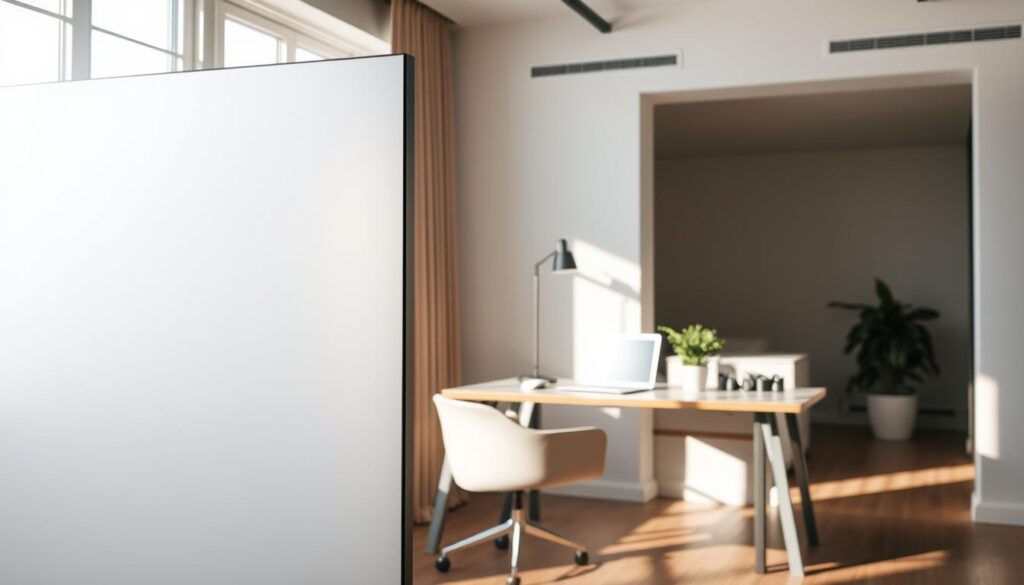
Separation level: visual privacy vs. partial screening
Decide whether you need full visual privacy, a partial screen for video calls, or just a clear cue that you shouldn’t be interrupted.
Choose the minimum effective privacy so you avoid oversized partitions that cut light or feel overbuilt.
Flexibility: portable, folding, and reconfigurable options
Portable and folding dividers are made to be reconfigured on demand. Brands like National Business Furniture and Versare offer modular panels that move when your schedule does.
Comfort goals: reducing distractions and supporting daily routines
Comfort ties to outcomes: fewer interruptions, easier transitions between work and home, and a predictable place to start and stop the day.
- Match separation to your actual needs first
- Prioritize flexibility if your layout changes
- Layer shelves and partitions when you want storage plus screening
Measure Your Space Like a Pro Before You Choose a Divider
Before you buy, map the layout so the shelving fits the way you move through space. A quick plan prevents a crowded corner and keeps light flowing where you need it.
Right-size the unit for your apartment layout
Measure floor width, ceiling height, and furniture footprints so the shelving creates a true boundary without blocking main circulation. Aim for a size that marks the work area but leaves clear paths for daily movement.
Plan doorways, walk paths, and natural light access
Check door swings, closet access, and your daily walk paths. Place shelving to avoid interfering with those routes and to preserve window light so the room stays bright and airy.
Choose height and width for the results you want
Taller units give more privacy; wider units strengthen zoning. Lower or open options keep the apartment feeling expansive. Test placements with painter’s tape or stacked boxes to validate before you buy.
- Map available space and mark furniture
- Right-size to protect circulation
- Preserve light and access with smart placement
Shelving-Unit Room Dividers vs. Office Partitions and Panels
Shelving and panel systems solve similar problems, but they do it in very different ways. Pick the route that matches your daily needs: visible storage and style, or fast, consistent coverage for focus.
When shelves beat panels for storage and zoning
Choose shelving if you want the unit to act like furniture. Shelves add storage, let you style with books and plants, and create a softer boundary that still signals “work.”
When office partitions beat shelves for quick setup
Go with panels or office partitions if speed and uniform coverage matter most. Many collections—like Tattoo, Shift, and Framewall—arrive fully assembled or ready-to-assemble so you get privacy fast.
Mix-and-match solutions for modern office flexibility
Combine a shelving run with a single panel to add targeted privacy at desk height. That gives you storage plus a focused sightline for calls.
- Compare on storage vs. speed vs. aesthetic functionality.
- Use shelves when styling and storage matter; use panels for an instant, clean boundary.
- Avoid units that are too low to block sightlines or too wide for your path.
- Evaluate product lines and configurations when you want a more workplace feel without construction.
Portable and Folding Dividers for Easy Move and Easy Re-Layout
Portable folding solutions let you set up a private workspace in seconds and collapse it when you’re done. They are ideal when your apartment also serves as a living or dining area and you need flexible separation without construction.
Accordion and foldable formats for fast setup
Accordion and foldable styles unfold quickly to block sightlines and then tuck away for storage. Many models from National Business Furniture are lightweight yet sturdy for repeated use.
Locking casters and lightweight frames for easy move
Look for locking casters so the unit stays put during calls. Lightweight frames make an easy move when you change layout or pack up at day’s end.
When to choose portable solutions
Choose this option when you need temporary separation for video calls, a quick “do not disturb” zone, or a short-term barrier for deep focus. They beat shelving when speed and mobility matter more than permanent storage.
- Placement tip: keep walk paths and doors clear to avoid trip hazards.
- Mobility tip: prefer caster locks and a low frame weight for frequent re-layouts.
- Use case: hide a distracting background during a call or build a pop-up office in shared spaces.
Office Divider Materials That Match Your Needs and Your Home
Start with maintenance goals: if you prefer low-effort upkeep, choose surfaces designed for quick wiping and regular use.
Laminate, aluminum, and steel are common when you want easy clean performance. Laminate resists stains and scratches, while aluminum and steel stand up to daily wear andwipe clean in seconds.
Fabric and tackable options for a softer finish
Fabric panels soften the look and make the area feel more home-like. Add a tackable surface to pin schedules and notes without cluttering your desk.
- Match materials to how often you move or reconfigure the layout.
- Pick finishes that hide scuffs if the unit sits along a busy path.
- Balance weight and durability: heavier means steadier; lighter means portable.
Tip: Favor easy clean surfaces where spills and fingerprints are likely, and reserve fabric or tackable faces for visible, low-touch zones.
Noise, Sound, and Acoustic Comfort in an Open Apartment Workspace
Sound moves easily through open layouts, but smart treatments can tame what you hear without sealing off your space.
How sound travels — in an open plan, reflections from hard floors and bare walls amplify voices and keyboard clicks. Even a partial partition or a shelving run changes where sound bounces and can noticeably reduce noise spill during calls.
Conference-call reality — placing a partition behind your desk helps reduce noise for others and improves your focus on the call. You won’t get perfect isolation, but you will cut reflections and interrupt fewer conversations.
Acoustic basics — choose sound-absorbing materials like soft-faced panels or proprietary products (for example, Arktura Soft Sound®). Panels damp reflections and make the space feel less harsh.
- Targeted coverage: treat the area where you talk and where sound hits the ceiling or nearby wall instead of treating the whole apartment.
- Ceiling-to-wall ideas: mimic SoftGrid® concepts with local hanging baffles or mounted panels to block key reflection paths.
- Visual tradeoff: use patterned or open acoustic panels to control noise without fully blocking visual access.
Prioritize materials, the coverage area, and the placement of the partition relative to the sound source when your main pain point is noise. Small, well-placed treatments often reduce noise more cost-effectively than full-room solutions.
Privacy Screen Strategies That Still Keep Your Apartment Feeling Open
A focused privacy screen keeps the camera view tidy and leaves the rest of your apartment bright and usable. Use targeted screening to hide only what appears on camera, not the whole layout.
Partial screening to protect your video-call background
Cover the camera frame, not the entire room. A mid-height screen or a slim shelving face will block the messy backdrop while letting light pass above and below.
Angle, placement, and sightline tricks that add privacy
Angle the divider slightly off the desk so the lens sees a clean plane. Offset the unit a few feet behind you to create depth and reduce busy elements in view.
- Block entry sightlines: place screening so the main door or sofa isn’t directly behind you on calls.
- Keep gaps for light: use open slats or partial panels to preserve brightness in the space.
- Start small: use a portable screen and scale up privacy later if you need more coverage.
Decide where privacy matters most (doorway, sofa, or kitchen line-of-sight) and place the screen to address that angle first. Treat privacy as a spectrum so you can adapt the solution as your needs change.
Design and Colors: Make Room Dividers Look Intentional
Color choices shape how your work zone feels and how it fits into the rest of your home.
Use color and finish to set tone: darker hues like black and deep gray read as more defined and office-like. Lighter shades such as white keep a small space airy and open.
Pick from a clear palette
Dividers come in a wide selection of colors: black, gray, white, red, green, and blue. Choose a variety colors approach if you want contrast, or stick to two tones for a calm look.
Contemporary vs. transitional
Contemporary design favors clean lines and minimal finishes. Transitional pieces blend classic touches with modern proportions.
Match finishes for cohesion
Align the finish of the partition with your shelving and furniture so the setup reads as one intentional unit.
- Perception: darker colors feel formal; light tones feel spacious.
- Color range: black, gray, white, red, green, blue—test samples in your light.
- Style match: pick contemporary for sleek flats or transitional for mixed-materials.
- Zones: use a work-zone palette versus a living-zone palette so one room supports two purposes.
When your partition looks like part of the decor, you’ll use it more and keep your workspace set up. Thoughtful design and the right colors make the boundary feel intentional in a modern office at home.
Fixed vs. Modular Walls: Choosing a Wall-Like Partition Without Construction
Choosing between modular walls and fixed panels comes down to how permanent and private you need the space to feel. Start by matching the product to your daily routine: do you want a stable background for frequent video calls, or a flexible setup you can reconfigure?
Modular walls for a more permanent “office partition” feel
Modular wall systems give the look and coverage of a built wall without construction. They bolt or interlock into freestanding runs, let you add glass, fabric, or storage faces, and often accept shelves and cable management.
When fixed panels outperform movable dividers for privacy
Choose fixed panels when you need consistent privacy and acoustic performance. A fixed panel or tight-seal run reduces sightlines and reflections more reliably than a lightweight movable option.
Installation options that fit renters and homeowners
Renter-friendly choices include freestanding modular systems and tension-mounted frames that avoid drilling. Homeowners may prefer semi-permanent mounts for extra stability and sound control.
- Compare permanence: movable pieces trade permanence for flexibility.
- Match privacy needs: pick fixed panels for daily calls and focused work.
- Installation tip: favor non-invasive mounts if you rent; use anchored systems if you stay long-term.
Ultimately, pick the boundary solution that fits your schedule and comfort. The right choice gives you a proper wall-like feeling while keeping future layout changes simple.
Assembly and Setup: Fully Assembled, Ready-to-Assemble, and Everything Between
The way a unit arrives can be the difference between a same-day setup and a weekend project. Choose the shipping format that fits your schedule, tools, and available floorspace so the product works for you from day one.
What “fully assembled” saves you in time and hassle
Fully assembled units arrive ready to place. That means fewer steps, fewer chances for mistakes, and a faster time-to-working—important if your office is critical to daily routines.
When ready-to-assemble is the better value
Ready-to-assemble options usually cut cost and lower shipping bulk. If budget matters more than immediate setup speed, RTA can be the best solution.
- Check partially assembled claims—sometimes only legs or panels come attached.
- For apartments, limited floor space for building favors fewer parts and simpler instructions.
- If you plan to reconfigure often, pick products with fewer connectors and lighter components so future moves are easier.
Decision tip: match the assembly style to your needs—choose fully assembled for speed, RTA for savings, and partially assembled only after confirming what’s done in advance.
Functional Add-Ons That Make Dividers Work Harder
Add-ons turn a basic partition into a multiuse tool that handles planning, power, and privacy. Good extras increase the overall functionality and change the value equation: a boundary can be a planning surface, a charging zone, and a background for calls all at once.
Tackable surfaces for notes, schedules, and workflow
Use a tackable panel as a low-cost pinboard when you lack wall space. Pin reminders, weekly schedules, and project notes so your workflow stays visible and organized.
Powered dividers for modern tech needs in small spaces
Powered models add outlets and USB ports to solve limited-plug problems. They cut cord clutter and let you charge devices without running long extension cords across the floor.
Pairing shelving with screens for storage plus separation
Combine shelving and a slim screen to get the best of both worlds: storage on one side, a clean backdrop on the other. This setup supports your daily office habits without sacrificing light or flow.
- Checklist: cord routing, stability, and placement near your desk or seating.
- Tie add-ons to specific needs: calls, cable control, visual privacy, or task planning.
- Avoid feature overload—pick one or two extras that solve your biggest pain points.
Best Layout Ideas for Defining Your Workspace Boundary with Shelving
Place shelving perpendicular to the main traffic line to carve a clear workspace without building a wall. This placement “cuts” a room into distinct work and living zones while keeping sightlines open above the shelves.
Perpendicular placement to cut a room into work and living zones
Line a shelf at a right angle to the flow of people. It creates a clear visual split and redirects walk paths away from your desk.
Back-of-sofa setups using shelving as a visual wall
Use the back of a sofa as an anchor. Put a shelving face behind the couch so the unit reads like a low wall and hides work clutter from the living side.
Corner office creation for maximum comfort in small spaces
Fit shelving into a corner to reduce open sightlines and make the area feel more contained. A corner layout boosts privacy and makes it easier to focus.
- Focus tip: keep pass-throughs out of the camera view to limit distractions during calls.
- Spacing: leave at least 36 inches for chair clearance and 30 inches for walk paths.
- Lighting and camera: plan light sources and camera angles as you place shelves so your home setup works on video.
Product Styles and Collections to Know When You Shop
Start with collections that simplify choices: consistent finishes, modular parts, and clear specs make buying easier.
Freestanding and flexible solutions for open-plan living
Freestanding product lines like FREEstanding and Modular Walls are ideal for rental-friendly setups. They move with you and avoid construction.
Modern office looks that still feel at home
Collections such as Tattoo, Shift, Framewall, and Space Max favor clean lines and neutral finishes. That makes a work area read as a modern office without clashing with decor.
- You translate collections into shopping value: predictable finishes and modular compatibility.
- Evaluate the range of options—portable, folding, tackable, and powered—by privacy, mobility, and aesthetics.
- Shortlist by constraints first: size, mobility, and assembly, then pick a collection that matches your style.
When you compare office dividers from known collections, you buy with confidence. Choose pieces from the same range to keep a cohesive look. This approach saves time and helps the product fit your daily life.
Buyer’s Checklist: How to Choose the Right Office Dividers and Partitions
Begin by defining what must be hidden and what can remain visible before you shop. That clarity helps you pick the right size, coverage, and level of privacy for daily work.
Size, coverage, and separation
Measure the area you’ll protect. Note ceiling height, walkway clearance, and camera sightlines. Match the unit’s size to the visual coverage you need—partial screens for video calls, taller partitions to block full-body view.
Mobility and storage for flexible spaces
Decide if you need casters, foldability, or built-in storage. Mobile dividers let you reconfigure the layout without heavy lifting. Shelving faces add storage so the solution works like furniture, not just a screen.
Materials and upkeep
Pick finishes that match your maintenance habits. Laminate, aluminum, and steel are low-maintenance and wipe clean easily near entryways or kitchens. Fabric faces add warmth but require more care.
Style, color, and final checks
Choose a design that complements your modern office aesthetic—contemporary lines or a transitional look. Confirm stability, return policy, and assembly needs before purchase.
- Quick test: measure twice and simulate placement with tape or boxes.
- Privacy check: mark what must be hidden (camera, desk surface, whole body).
- Final fit: pick the simplest partition that meets your needs and moves with you when life changes.
Conclusion</H2:
A clear boundary makes your home feel like two purposeful spaces rather than one.
Use a room divider approach that fits your routine: shelving for storage and style, panels for quick privacy, and office partitions for more consistent coverage. Brands like National Business Furniture and Versare offer modular and portable options that avoid permanent work.
Measure first, keep walk paths and light clear, and pick height and coverage for the result you need. Comfort matters: reducing distractions and supporting daily routines helps you actually use the workspace.
Next step: shortlist 2–3 options, compare materials and assembly level, then choose the simplest solution that meets your needs. Include a skip main link for page flow so users land on the practical next step.
When you define the boundary, your apartment becomes more functional and your workday feels more contained.