

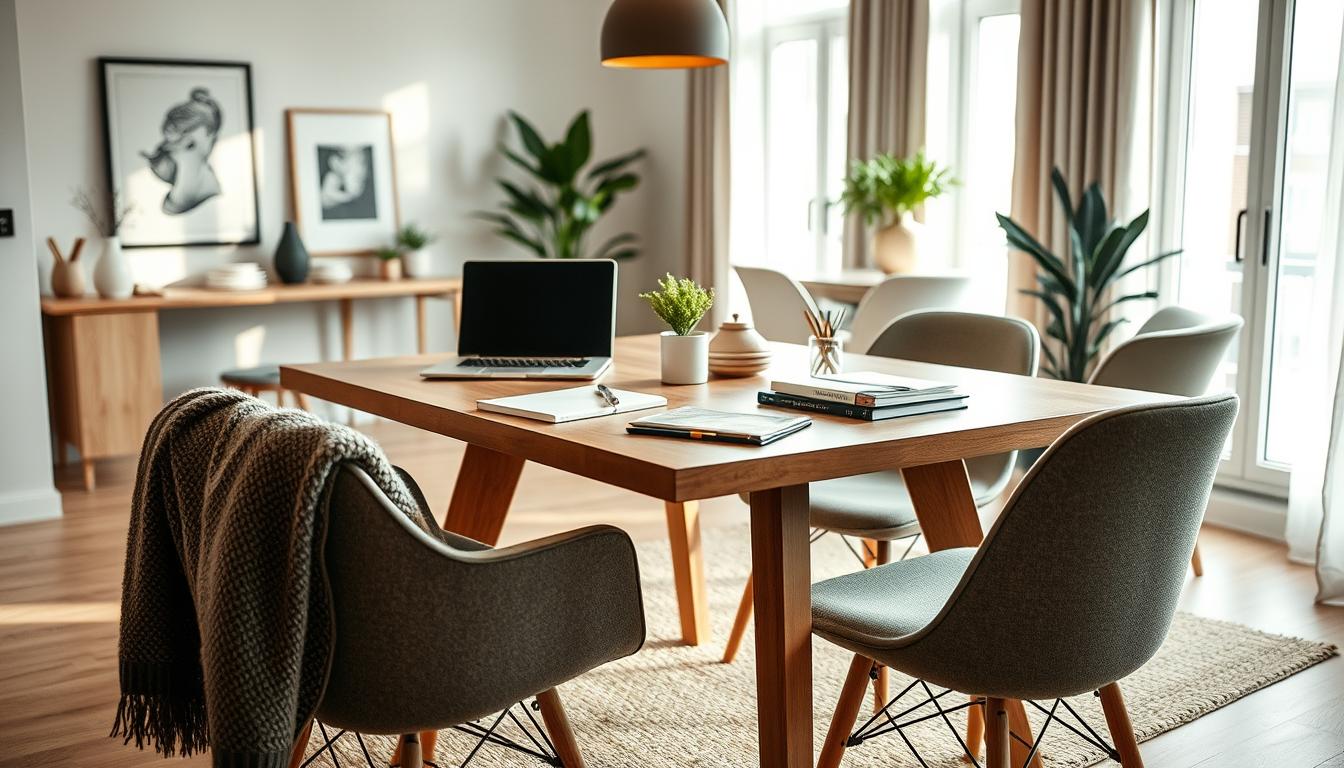
You can turn your dining table into a credible workstation without letting your home become a permanent office. This guide promises clear steps so you can work, eat, and reset quickly.
We preview simple upgrades you can pair with your table—nesting tables, storage benches, and tech-friendly seating—to make hybrid life easier. You’ll learn practical design choices that keep video calls tidy and dinner setup fast.
Define multifunctional furniture: one piece that serves two or more roles. Think sofa beds, or a table that hosts meals and meetings.
This is for small apartments, studios, open plans, families, and pet owners who want fewer extra pieces. When you buy a table to use daily, focus on stability, durable finishes, and long-term value.
Expect fewer items to store, a faster reset at dinner time, and a cleaner look on camera. Read on for smart, commercial tips to choose the right table and accessories.
Why your dining table is the easiest home office upgrade in a hybrid home
Your dining table is the quickest, least expensive upgrade to create a real work zone at home. You already own it, it sits in a central room, and it’s built for daily use.

How multifunctional furniture reduces clutter in small homes
Multifunctional furniture lets one piece do many jobs, so you buy fewer items and free up floor space. In tight layouts, adding a second full-size desk often creates visual clutter and cuts into usable space.
What you gain when one table supports dining, work, and everyday living
Using one table for dining and work gives you a consistent routine and faster transitions from work to life. You get fewer cables scattered around and one clear surface to reset each evening.
- Low friction: no new purchases or assembly.
- Flexible anchor: morning focus, night meals with a quick tidy.
- Fewer pieces to store—so the living room looks like living, not an office.
Later sections cover ergonomics, lighting, and storage add-ons so your table functions well without turning your home into a permanent office.
What “multifunctional furniture” means for your work-from-home setup today
In a modern house, a single piece can solve your daytime workflow and overnight guest needs. Think beyond a desk: choose items that add sleep, storage, charging, or room division while you work.

Real examples that go beyond a desk
Sofa beds turn a living area into a guest-ready room in minutes. A convertible sofa gives you seating and a sleep surface without extra bulk.
Storage beds free up closet space and reduce the need for dressers. Storage benches and desks with shelves keep chargers and papers out of view.
Why mechanisms and materials matter
- Mechanisms: hinges, sliders, and lift-tops should move smoothly and lock solidly so parts don’t loosen with daily use.
- Materials: prioritize solid wood frames where it counts, durable finishes that resist scratches, and metal components that stay tight.
- Value: paying for reliability saves you time and hassle compared with replacing wobbly parts after a few months.
Once you know what qualifies as multifunctional, you can pick the right table size and add compact accessories without overfurnishing your home. Later sections show how to size and style your core pieces for long-term use.
Choose the right dining table shape and size for working comfortably
Start with the table: the right shape and scale will solve most hybrid space problems. Pick a form that fits traffic flow and gives you the surface you actually need.
Small space wins
For tight rooms, a round dining table keeps movement smooth and fits into corners without sharp edges. A narrow rectangular top works well against a wall. Consider a drop-leaf dining table with two 9″ leaves so you expand only when needed.
Surface area planning
Plan for a laptop plus a monitor riser, a notebook or two, and a cup of coffee without crowding. Allow at least 24″ depth for wrists and forearms and 36″ width if you use a monitor.
Legroom and clearances
Ensure table legs don’t block knees and that chairs slide fully under the top. Test with your chairs to confirm comfortable posture and clearances for dining.
- Durable surfaces: choose scratch-resistant, easy-clean finishes.
- Material: wood or metal frames with sturdy components last longer.
- Buy-up logic: a better-built table often outperforms a cheap desk.
Set up an ergonomic workspace without turning your dining room into an office
D with small changes you can have an ergonomic workspace that packs away fast at dinner time. The goal is comfort, quick reset, and keeping the room for living when work ends.
Dial in chair height and posture
Adjust your chair so your elbows sit near table height and your forearms are level. If the chair is too low, add a firm cushion or a folded towel to raise your seat.
Keep wrists neutral, shoulders relaxed, and feet supported. Raise your laptop on a riser so the top of the screen sits at eye level to avoid neck strain.
Create a portable desk zone
Build a small kit you stash in a drawer: a tray for chargers, a desk mat to mark your work area, and a lightweight riser for the screen.
When work ends, slide the tray under the table or into a cabinet so things disappear in under a minute.
Lighting basics for comfort and video calls
Face a window or soft lamp when possible to keep your face lit for calls. Avoid harsh overhead glare on the tabletop by angling lamps or using diffused bulbs.
Small habits—like a one-minute reset each evening—keep the table usable and prevent work from spilling into family time.
Multi-purpose furniture that makes dining-table work easier
A few well-chosen pieces let your dining area pull double duty for work and meals. Choose add-ons that solve charging, extra surface, and clutter without crowding your room.
Tech-friendly seating and recliners with USB
Seating with built-in USB ports lets you move from focused table work to a relaxed reading session while devices stay charged. A reclining chair with USB keeps a phone or tablet topped up during long calls.
Storage benches and hidden compartments
Use a storage bench or a hidden-compartment piece to clear the tabletop fast. Stash chargers, adapters, and notebooks out of sight so dinner is always one motion away.
Nesting tables as side surfaces
Nesting tables act as instant side tables for a second screen, printer, or a stack of notes. When work ends, tuck them under a console to reclaim open floor space.
Desks with shelves for tighter workflows
If you need a more office-like layout, a compact desk with shelves adds vertical storage without a large footprint. Keep cables and reference material off the dining top and on dedicated shelves.
- Benefits: saves space, reduces clutter, and targets specific pain points (charging, surface, storage).
- Modular approach: add only what you need to protect your space and budget.
- Design tip: match finishes so the new piece reads as part of your room, not a separate office.
Convertible coffee table ideas when the dining table isn’t available
When your main table is occupied, a well-chosen coffee table can step in as a quick, comfortable workspace. Use it for short sessions, urgent calls, or when the dining top is set for a meal.
Smart centers that do more than hold a cup
Premium smart coffee models act as an all-in-one hub. Look for built-in charging ports, Bluetooth speakers, and LED lights that set mood and improve visibility. Some, like the Sobro Design, add a mini fridge under a tempered glass top and a touch control panel.
Lean C-shaped and lift-top options
C-shaped side table designs slide under a sofa or bed, so you can work close to seating without moving large pieces. For laptop work, prefer lift-top or stable height tables with enough surface for a laptop and mouse and controls within reach.
Pet-friendly bases that keep pets happy
Choose a coffee piece with a hollow base or igloo-style hideout so your pet has a cozy den. That keeps your living room tidy and gives your pet a safe retreat while you work.
- When to use it: roommates on the dining table, a set meal, or a short posture change.
- What to check: stable lift mechanism, surface area for laptop + mouse, accessible usb and touch controls.
- Hybrid benefit: a secondary work surface reduces conflict and keeps your main table ready for family time.
Wall-mounted and fold-down solutions for tight layouts
When floorspace is tight, walls become your best tool for creating a focused work zone that tucks away fast.
Wall art that converts into a working surface
Some designer pieces hide a desk behind attractive art. The Flow desk by designer Robert van Embricq folds from wall art into a usable top with one hand.
Brass hinges and wooden slats lock the top in place and add privacy while you work. When closed, it reads as décor so your living room stays lived-in, not office-like.
Drop-down tables that vanish at the end of the day
Drop-down wall tables retract to become a picture, mirror, or chalkboard. Makers on Etsy (HmDcrtnsArt) show how a single panel can serve as decor and a stable work surface.
These tables offer a fast reset—fold away and your dining routine resumes with no extra storage required.
Room dividers with built-in shelves for a “workspace wall”
Folding room dividers with shelves create a visual barrier and add storage. Bamboo panels with sliding boards form sturdy shelves that hold a monitor, supplies, or plants.
- Why it works: you gain a true work zone without claiming a whole room.
- Placement tips: pick a wall near power, allow knee clearance, and test the folding mechanism for daily use.
- Design note: choose pieces that match your room so the work area feels intentional and stylish.
Dining table styling tips that help your workspace blend into your home design
Style choices make a work-ready dining surface feel like an intentional part of your home. Treat the table as a designed zone, not a temporary desk. Small, consistent details make your workspace read like the rest of your living area.
Use matching organizers, trays, and baskets
Pick trays and baskets that echo the room’s materials—wood tones, metal finishes, or woven textures. Matching organizers keep chargers, pens, and notebooks in one tidy spot and make things look deliberate.
Keep a camera-ready centerpiece
Choose one low-profile piece you can slide aside quickly—a tray with a small plant or a candle works well. Keep a compact tray for daily work items so you can clear the top in seconds before a call.
- Color and material continuity: match the piece and accessories to your table and room for cohesion.
- Visible from all angles: anything that stays on the table should look good from the camera and from across the room.
- Reduce friction: when your setup looks like decor, you’re more likely to reset it each evening and keep clutter under control.
Storage strategies that let you reset the table for dinner in minutes
Design your storage so clearing the table is fast and automatic. With a short playbook you remove decision fatigue and restore the room for family time.
Ottomans, stools, and benches that hide work gear
Keep one container for daily essentials and another for occasional items. This prevents overflow and makes clearing the table a one-move task.
Use ottomans, a storage bench, or stools with lids to stash chargers, notebooks, and adapters. They double as extra seating and free up the table surface in seconds.
Floating shelves with task lighting to clear the tabletop
Install floating shelves with led lights above the table to lift items off the surface and add useful task glow. Shelves create vertical storage without taking floor space.
Place storage within arm’s reach of the table but out of the main walking path. Fewer loose cords and fewer scattered items improve both the look and safety of your home.
- Quick reset: one bin for daily items, one for the rest.
- Placement tip: shelves and seats near the table, not in traffic.
- Bonus: neat storage protects against trip hazards and keeps the room camera-ready.
Hybrid layouts for small spaces like apartments, studios, and open-plan living rooms
In tight urban homes, clever layout moves let one table serve meals, meetings, and downtime without feeling crowded.
Using a bar table set as a slim work surface
Choose a slim bar table set with a built-in power strip and USB ports so devices stay charged without extra cords. A practical size is 5 ft long, 20″ deep, and 36″ high; it fits narrow layouts and still seats two.
When a small dining set with fold-down leaves is better
A small dining set with two 9″ drop leaves gives you flexibility. Expand when you host. Fold down on workdays to free walking space and keep the room feeling open.
Positioning the table as a room divider
Place the table so it defines a living and dining zone. Use its long side as a soft divider; a low base or bench behind it keeps sightlines open without a wall.
- Flow tip: leave clearance for chairs and a 30–36″ path behind seated people.
- Daily habit: keep a tray for work items so clearing the surface takes one motion.
- Best way: orient the piece to support movement between kitchen and living areas while serving work needs.
Family- and pet-proof your multi-use table setup
Keep daily chaos in check by choosing durable surfaces and simple cable routines for your shared table. Small choices protect the table from spills, scratches, and heavy use so the space stays usable for both meals and work.
Durability priorities
Choose a solid wood frame or a metal-reinforced base for any table you plan to use daily. These frames resist wobble and last longer under repeated use.
Pick sturdy mechanisms for lift-tops or drop leaves so hinges and sliders hold up over time. Nearby seating should have easy-clean fabrics—wipeable sofa covers or treated chair upholstery make spills simple to manage.
Cable routing and charging habits
- Route cords along edges and secure them with clips or cord channels to keep walkways clear and reduce trip risks.
- Set a single charging zone—a small tray or a dock near an outlet—and store spare cables immediately in nearby storage so the table returns to dining use fast.
- Use stable bases for power strips and avoid draping cables across the table or floor where kids and pets can tug them.
These small systems keep your house safe and your space tidy. Good cable management also makes the room look calmer and helps the whole piece of furniture read as intentional, not improvised.
Buying checklist for a dining table that works like a desk
Shop for a dining table that performs during a long video call and still clears fast for dinner. Focus on lasting build, sensible edges, and a warranty that matches how often you’ll use the top.
Stability, wobble-free construction, and long-term value
Prioritize stability first. Test joinery, leg bracing, and tabletop thickness in-store or read details online. A solid base prevents monitor shake and protects hardware during long use.
Finish and edge details that handle daily “desk” wear
Pick rounded edges for forearm comfort and a durable finish that resists scratches and stains. Look for scratch-resistant coatings and sealed edges to protect the top over time.
What to look for in warranties and reviews for frequently used pieces
- Read reviews for repeated notes on stability and surface durability.
- Prefer longer warranties on mechanisms and tops; they signal confidence from the designer or maker.
- Consider built-in storage options so you buy fewer extra pieces and save time clearing the surface.
Conclusion
A well-tuned table can be the single smart upgrade that keeps work, meals, and family life in balance.
Choose the right size, set up comfortable seating, and add quick storage so the top works for long calls and clears fast for dinner. Pairings that pay off: nesting or side surfaces, tech-friendly seating with USB, floating shelves, and a small stash organizer for daily tools.
If the dining top is full, a sturdy coffee table or sofa zone works for short sessions. Pick pet- and family-friendly finishes and bases to protect your investment.
When you shop, prioritize stability, durable finishes, and reliable mechanisms that resist wobble. Finally, solve one daily pain—clutter, charging, lighting, or space—with a single upgrade, then expand with a few well-chosen pieces.