
You want a room that adapts to work, meals, and relaxing without a remodel. Variable brightness means you change output to match the task or the mood right now, not live with one fixed setting all day.
In many U.S. homes, open plans and work-from-home setups make a single level of lighting unrealistic. Brands like TCP Lighting and Residence Supply note that intensity control moves a space from vivid and energizing to soft and cozy in seconds.
What you’ll get: practical control for tasks, improved design and comfort, lower energy use, and often longer LED life. The guide ahead shows how dimming works, how to plan zones by activity, which hardware to choose, and how different dimmer tech affects smoothness and flicker.
– Learn how variable brightness supports both function and mood.
– Plan zones and choose compatible hardware for smoother performance.
– Focused on modern LED-friendly solutions and legacy dimmers you may already have.
Why multi-use rooms need lighting you can adjust in real time
In many households a single living area must shift roles from productive to passive in minutes. Your room should let you change brightness and mood quickly so the same space works for work, dining, and downtime.

Think about a typical day: morning emails demand bright, focused lighting for your home office corner. Afternoon homework needs clear, even illumination. Evening dining benefits from warmer, moderate levels. Late-night movie time calls for low, cozy settings.
Real-time control matters because natural daylight and activities change fast. You can cut glare on screens, avoid washed-out TV images, and keep enough light to move safely without swapping bulbs or lamps.
- Too bright: glare on monitors, harsh shadows, a clinical feel that hurts your mood.
- Too dim: eye strain when reading, unsafe navigation, poor visibility for cooking.
- Practical mix: bright for a call, medium for guests, low for a movie, task spot for cleanup.
Goal: design layered lighting and easy controls so one space supports many needs with simple, immediate adjustments.
How dimmable lighting works with today’s bulbs, fixtures, and controls
Flexible output depends on more than one component. A truly adjustable system pairs a compatible bulb, the correct fixture or driver, and the right control. When these work together, you get smooth changes in brightness and reliable performance.
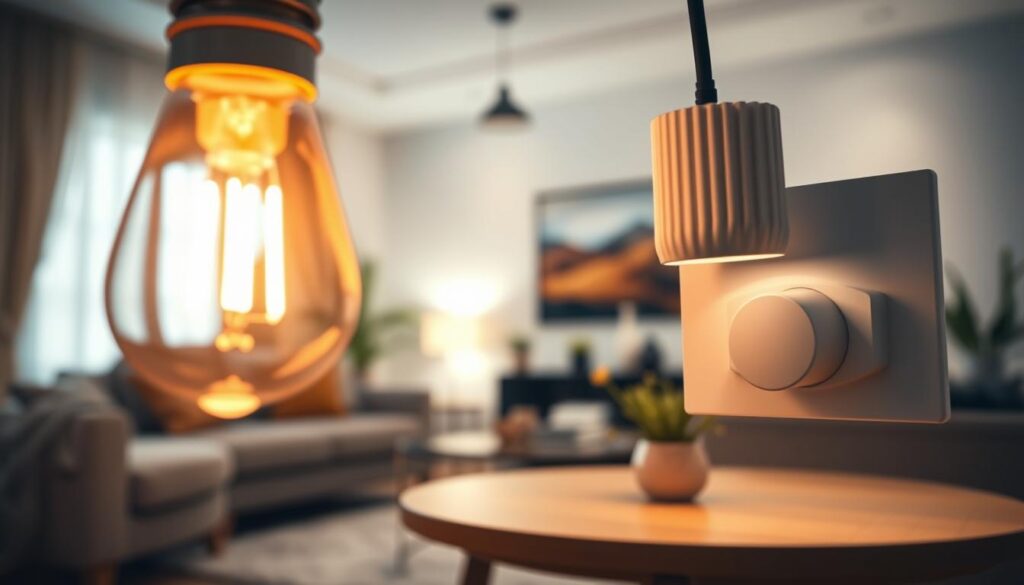
What makes a bulb or fixture truly adjustable
Look for package and spec labels that explicitly state compatibility. A fixture or bulb that supports a dimming range will list rated drivers, minimum load, and recommended dimmer models.
How dimming lowers illumination
In plain terms, dimming reduces the delivered power or alters the control signal so the lamp emits fewer lumens. Methods include lowering current, using pulse-width modulation (PWM), cutting parts of the AC waveform (leading or trailing edge), or sending a 0–10V control signal to a dedicated DC driver.
Why early LED setups buzzed and what’s better today
Early LED dimming often buzzed or flickered when legacy methods cut voltage. That happened because LED drivers and many bulbs didn’t match older dimmer designs. Modern LEDs and LED-rated dimmers now reduce flicker and give a wider usable low end.
- Check before you buy: compatibility lists, minimum load, and whether the fixture has an integrated driver.
- Remember: the system is bulb + fixture/driver + dimmer or switches; one mismatch can cause problems.
Plan your lighting by activity, zone, and mood in a multi-use space
Map your living space to match how you use it through the day. Start with a simple sketch and mark the key areas you use for work, dining, and relaxing.
Map your room into areas and lighting layers for flexible control
Define functional areas: desk corner, sofa/TV wall, dining table, and pathways. Treat each area as a separate zone so you don’t over-illuminate the whole space.
Choose brightness levels for task vs. ambient atmosphere
Set task lighting to the level you need for clear visibility. Then lower ambient layers to cut glare and create balance.
Use adjustable lighting to shift color feel from energizing to cozy
Color temperature matters. Cooler tones support focus; warmer tones support relaxation. Selectable or tunable LEDs let you change the atmosphere without swapping fixtures.
Create simple scenes for everyday use
- Workday: brighter task + moderate ambient for focus and comfort.
- Dinner: lower ambient + warm accents to set a calm mood.
- Movie: very low ambient + gentle pathway level for safe movement.
Account for daylight: you may need less overhead output in bright afternoons and slightly more in the evening to keep the space consistent. Avoid relying on one fixture—mix floor lamps and sconces for better control and fewer harsh shadows.
Choose the right setup: dimmable bulbs, dimmer switches, or smart dimming
Pick hardware that matches how you use the space, from a single lamp to a whole-room system. Your choice shapes control, convenience, and long-term reliability.
Dimmable bulbs vs. dimmer switches: what each one controls
Bulbs and fixtures must support dimming at manufacture for smooth operation. The wall dimmer or fixture control is what changes output day to day.
Dimmer styles for modern homes
Rotary is simple and budget-friendly. Slide offers finer tuning. Smart dimmers add schedules, app and voice control for a connected home.
LED compatibility basics
Use LED-specific dimmer switches when you have led lamps. Check compatibility lists to avoid flicker and uneven performance.
Match ratings to wattage and safety
Confirm the dimmer’s wattage rating matches the total load. If wiring is old, multi-way, or buzzing persists, call a licensed electrician.
- Quick checklist: what you control, bulb compatibility, dimmer type, total wattage, and proper installation.
Understand dimming technology so you get smooth, reliable brightness control
Different dimming systems behave very differently; knowing which one suits your setup prevents flicker and buzz.
Analog control and driver limits
Analog dimming reduces current to the LED. That sounds simple, but some LED drivers don’t scale evenly. When a driver fails to track current, you may see uneven steps or color shifts as levels fall.
Pulse-width modulation and video artifacts
PWM switches LEDs on and off at fast intervals. Your eyes often miss it, but cameras can record flicker or strobing. If you record or stream, choose drivers and dimmers designed for high-frequency PWM or another method to avoid artifacts.
Leading-edge vs. trailing-edge on legacy wiring
Older dimmers cut the AC waveform. Leading-edge or trailing-edge chopping was fine for incandescents but can cause buzz or visible flicker with modern fixtures. For most retrofits, an LED-rated trailing-edge dimmer gives the best day-to-day result.
0-10V for precision and lower energy use
0-10V uses a dedicated DC control signal to a compatible driver. It delivers accurate settings, solid low-end performance, and lower energy consumption at reduced levels. It costs more to retrofit but pays off where precise control and long-term energy savings matter.
- Selection tip: for simple retrofits pick an LED-rated trailing-edge dimmer; for whole-room installs consider 0-10V.
- Troubleshooting cues: buzzing = waveform incompatibility; flicker at low levels = driver/dimmer mismatch; stepping = poor control resolution.
When your dimmer, driver, and LEDs match, your illumination stays steady, your power use drops when full output isn’t needed, and the space feels higher quality.
Dimmable light benefits for energy efficiency, comfort, and longer-lasting lighting
Controlling how bright your room is gives you savings and comfort that add up every day. You get measurable energy savings while making the space easier on your eyes.
Energy savings and lower consumption
Cut power use without changing fixtures. LEDs run far more efficiently than older bulbs—up to 90% in some cases. Arsen Electric notes that dimming lights by 50% can reduce power draw by about 20%, which adds real savings in high-use rooms.
Longevity gains
Running LEDs at reduced output lowers stress and heat on drivers. That can extend lifespan; some products are rated up to 50,000 hours, per TCP Lighting and Residence Supply.
Comfort, control, and atmosphere
You reduce harsh brightness, ease eye strain, and support evening wind-down. Use lower levels to highlight artwork or textures and higher levels for tasks.
- Practical savings: less consumption, lower monthly bills.
- Longer life: reduced wear on LEDs and drivers.
- Better mood: simple control to set atmosphere and focus.
Why it matters: dimming gives a better daily experience and measurable efficiency over time—small changes in brightness bring lasting savings and quality of use.
Conclusion
Conclusion
Good design ends with a simple test: does your room do every job well when you adjust brightness? If so, you have the flexibility to shift from work to dining or movie time without a fuss.
Follow the path in this guide: define activities, zone the space, layer your lighting, pick compatible bulbs and lighting fixtures, then add LED-rated dimmer switches or smart controls.
Compatibility is non-negotiable: matching dimmable lighting, dimmer hardware, and correct wattage prevents flicker and buzzing. Walk each room at different times and list where it feels too bright or too dim, then upgrade one zone first.
If you must change switches or worry about old wiring, hire a licensed electrician for safety and reliable results.