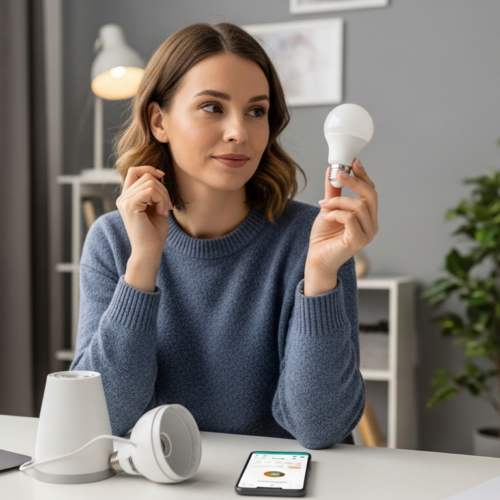


You use light cues all the time without thinking. Circadian lighting means arranging your home and workspace so lighting signals match parts of your day. This simple switch can support focus in the morning and help you wind down at night.
The main idea is straightforward: color temperature tells your brain if it’s time to be alert or relax. The Kelvin scale ranges from candlelike warmth to bright daylight. With that guide, you’ll learn practical ranges and how to map them to rooms you use most.
In the U.S., this matters for remote work, cooking under task light, and relaxing in the living room. The underlying science shows people read warm hues as evening and cool hues as daytime, which affects mood and focus.
What you’ll get: target Kelvin ranges, tips for layering light, and how to check bulb labels so you don’t mix temperatures. The best setup depends on your space and tasks, but consistent planning reduces visual discomfort and improves daily experience.
Circadian lighting basics: what color temperature means in your space
A bulb’s number tells you more than brightness—it tells your space whether to wake up or wind down.

How the Kelvin scale works
Kelvin (K) is the standard measure on most packaging. Lower numbers look warm and yellowish. Higher numbers read cool and bluish.
Key ranges to know
Use this simple guide to translate a number on a box into what the light will actually look like in your room.
- <2000K — candle-like glow
- 2000K–3000K — warm light for relaxing spaces
- 3100K–4500K — neutral, good for balanced tasks
- 4600K–6500K — bright blue-white for alert work
- 6500K+ — very cool, intense daylight
Why daylight matters for your body clock
Daylight is commonly anchored near ≈5200K. That baseline signals “day” to your brain and helps you feel alert.
Moving warmer or cooler shifts the mood. Cooler ranges usually boost focus. Warmer ranges nudge you toward rest.
Practical designer lens for rooms
“White” LEDs are not uniform. Choose a specific number based on the room’s use—rest, socializing, or focused work.
Match the target figure to the finishes and layered lighting you plan to use so each source reads consistently in your spaces.
Next: how these bands shape focus, mood, and productivity from morning to night.
Color temperature effects on focus, mood, and productivity from morning to night
Light shifts across the day steer your alertness and calm in predictable ways. Match the right color temperature to the task and the hour to boost focus or help you unwind.

Warm white for winding down (2000K–3500K)
Warm light in this range feels soft and less stimulating. It signals evening to your brain and reduces arousal.
This glow suits bedrooms and living rooms when you want to relax and prepare for sleep.
Neutral white for balanced work (3100K–4500K)
Neutral lighting balances comfort and clarity. Use it in home offices or shared rooms when you need steady focus without harsh glare.
Cool, blue-white for alertness (4600K–6500K)
Cool light raises perceived visibility and sharpness. It helps with detail tasks and food prep in the kitchen, but can feel too intense late at night.
Match the room and finishes
Woods and reds warm up under warm light. Blues and whites gain crispness under cool light. Think about your palette so the lighting supports the mood and productivity you want.
- Tip: Pick lighting that fits the task, the room, and your finishes for predictable results.
How to set up a circadian lighting plan in your home or workplace
A simple pair of targets—cool for day, warm for night—keeps your lighting consistent and effective.
Start by choosing two practical targets: an evening setting around 2700K–3000K and a day setting near 4000K–5000K. These common LED options are easy to find on packaging and work well across most rooms in a U.S. home.
Match the same target within each room so your lights read uniform. One mismatched built-in or lamp can make a space feel patchy and strain your eyes.
Layer three light sources for better focus: ambient for general fill, task for desks and counters, and accent to reduce glare and add depth. This setup prevents harsh contrasts and improves visual comfort.
- Dimmable and tunable white bulbs let you shift from cooler daytime light to a warmer evening glow without swapping bulbs.
- Check CRI—choose high CRI where accurate color matters, like closets, kitchens, retail, or galleries.
- Before you buy: read the Kelvin number, confirm if fixtures have fixed built-in LEDs, and double-check bulb labeling for consistency.
Don’t forget hidden sources—under-cabinet strips, mirror lights, or range hoods can undo your plan if they use a different setting. With matched lights and a simple two-target system, your lighting will support focus by day and calm by night.
Conclusion
Your lighting choices shape how each room supports work, rest, and routine. Use this guide to set a clear daytime target and an evening target so your space feels intentional every hour.
Simple rule: pick a day Kelvin near 4600K and a warmer setting near 2700K, then apply those color temperature ranges consistently across rooms. These bands give you a reliable framework for focus during the day and calm at night.
Match finishes and lamps so the color reads uniform. In open-plan living areas, treat lighting as a whole-home plan to avoid visual conflict and to boost daily comfort and focus.